Argan oil is used by the Amazigh people of Morocco to help reduce the appearance of scars and soothe rheumatic pain – among many other benefits. Today, Moroccan argan oil is one of the most popular beauty products on the market. It is widely sold in spice shops in the medinas of Morocco, but the quality varies, as does the price.
With few rules behind the “certified organic” label, you need to know a few facts to be sure you are buying the real thing. Whether you want it for its healing powers or for a new nutty flavour in your cooking, here’s what to look for when buying argan products in Morocco.
Morocco is the only country where the argan tree grows on a large scale. Its argan forests cover about 800,000 hectares around the Souss Valley, an area framed by the Atlas Mountains, the Atlantic Ocean and the Sahara Desert. They contain about 21 million trees and are protected by UNESCO as a biosphere reserve.
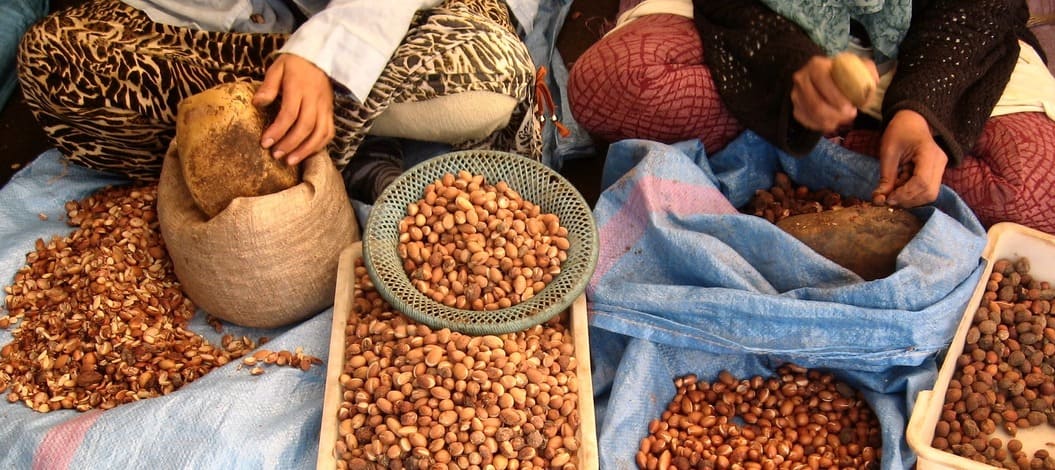
Argan nut shells are said to be 16 times harder than a hazelnut shell. Stories dating back to the 13th century tell how goats ate the argan fruit and local people later collected their droppings to retrieve the nuts, which had been softened by the animals’ digestion. This saved work by making the kernels easier to extract, but the oil had a distinct smell.
Argan Oil Benefits
Moroccan argan oil has a transformative power. Rich in vitamins, minerals and antioxidants, this age-old beauty secret has many uses, helping to hydrate and soften your hair, face, body and nails.
With its high content of antioxidants, essential fatty acids and vitamin E, argan oil naturally helps to revitalise the skin, increase the elasticity of hair and restore shine to dull hair. It is a powerful antioxidant that also helps protect against UV damage and free radicals.
Argan oil leaves hair beautiful, shiny and nourished with each use. On the skin, it hydrates and moisturises luxuriously, and it is also known to help reduce the appearance of wrinkles.
Culinary Uses, Cosmetic Uses and Benefits
Argan oil is usually used for dipping bread and drizzling over couscous or salads. However, its most popular use in Morocco is amlou.
Amlou
Amlou is a thick brown paste, similar in texture to peanut butter, made by grinding roasted almonds with argan oil and honey. It is a speciality of southern Morocco and is usually eaten as a dip or spread on bread.
For many centuries, argan oil was a key part of traditional Berber medicine, used for many illnesses such as rheumatism, heart disease and skin conditions. Over the past decades, it has also become a major ingredient in the beauty industry, as researchers discovered its exceptional anti-ageing properties. Argan oil contains 80% unsaturated fatty acids, and laboratory tests have shown that it has antioxidant properties, neutralises free radicals, protects connective tissue, restores the skin’s water-lipid layer and lowers bad cholesterol.
Many claims have been made about the health benefits of eating argan oil. Researchers believe that eating argan oil every day is “highly likely” to be one of the factors that help prevent diseases such as cancer, heart disease and obesity.
The only thing to remember about culinary argan oil is that it is not suitable for cooking, as it should not be heated.
Colour and Consistency
Real argan oil should be clear, though slightly cloudy, and a dull yellow colour. Oil that is too golden may have been mixed with other oils to keep the cost down – after all, it takes 30 kilograms of nuts to make one kilogram of oil. The oil should feel quite light on the skin, and even if the skin does not absorb it quickly, it will over time. Oil that is still there to wash off in the shower the next day may not be of the best quality or the purest.